

TL;DR
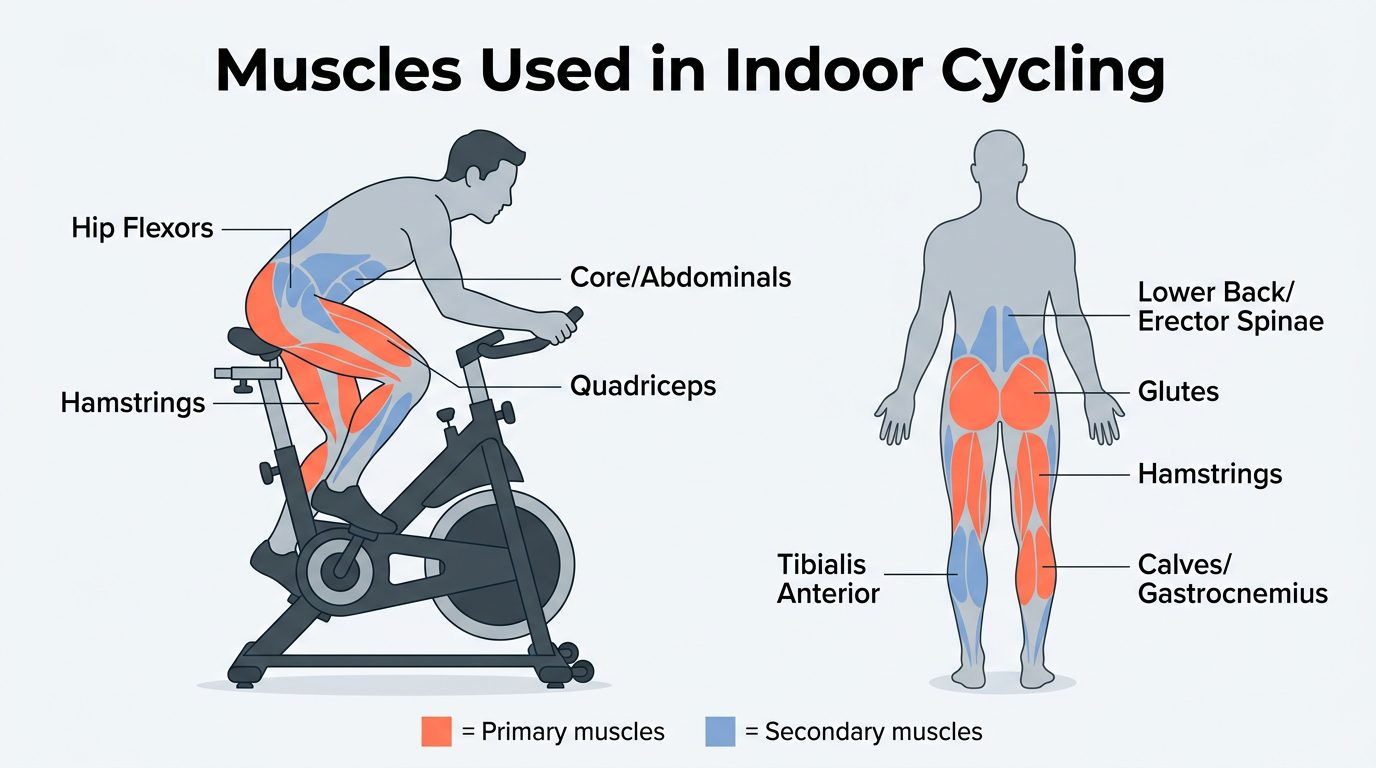
Indoor cycling primarily works the quadriceps, hamstrings, glutes, and calves: the four major lower-body muscle groups that drive the pedal stroke. It also activates the core (rectus abdominis, obliques, and erector spinae) for stabilisation, and engages the upper body (hip flexors, shoulders, and arms) to a lesser degree, particularly when standing or climbing. Regular sessions build muscular endurance, improve neuromuscular coordination, and, at sufficient resistance and intensity, can stimulate meaningful muscle development in the legs and glutes.
Indoor cycling works the quadriceps, hamstrings, glutes, calves, and core muscles as its primary targets, with secondary engagement of the hip flexors, lower back, and upper body depending on riding position and resistance level. It is a lower-body dominant, cardiovascular exercise that recruits multiple muscle groups through a continuous, cyclical pedal stroke across a full range of motion.
Primary and Secondary Muscles: At a Glance
The table below shows every muscle group activated during a standard indoor cycling session, organised by contribution level.
| Muscle Group | Role | Activation Level | Pedal Stroke Phase |
|---|---|---|---|
| Quadriceps (rectus femoris, vastus lateralis, vastus medialis, vastus intermedius) | Primary power production | Very high | Downstroke (1 o’clock–5 o’clock) |
| Gluteus maximus | Hip extension, power generation | Very high | Downstroke |
| Hamstrings (biceps femoris, semitendinosus, semimembranosus) | Knee flexion, pedal pull-through | High | Upstroke (6 o’clock–11 o’clock) |
| Gastrocnemius & Soleus (calves) | Ankle plantarflexion, power transfer | High | Bottom of stroke |
| Hip flexors (iliopsoas, rectus femoris) | Leg lift, upstroke assist | Moderate | Upstroke |
| Core (rectus abdominis, obliques, erector spinae) | Spinal stabilisation, power transfer | Moderate–High | Continuous |
| Tibialis anterior (shin) | Ankle dorsiflexion | Low–Moderate | Top of stroke |
| Shoulders & Arms (deltoids, biceps, triceps) | Handlebar support, upper-body drive | Low–Moderate | Standing/climbing |
| Upper back (trapezius, rhomboids) | Posture, handlebar pull | Low | Climbing position |
The Quadriceps: The Engine of Every Pedal Stroke
The quadriceps are the dominant muscle group in indoor cycling. These four muscles on the front of the thigh (the rectus femoris, vastus lateralis, vastus medialis, and vastus intermedius) generate the majority of power during the downstroke phase of each pedal revolution, roughly from the 1 o’clock to 5 o’clock position.
Research published in Biomedical Engineering Online (Bing et al., 2024) measuring electromyographic (EMG) activity during stationary cycling found that the rectus femoris and biceps femoris both showed significantly greater muscle activation at higher workloads, confirming that increasing resistance directly increases quadriceps recruitment. The vastus lateralis, the outermost quadriceps muscle, has been shown to modulate its shortening velocity as cadence increases, with research in Journal of Experimental Biology (Riveros-Matthey et al., 2023) demonstrating that this muscle operates most efficiently near each rider’s self-selected cadence.
In practical terms: if you want to maximise quadriceps development on the bike, increase resistance so the downstroke requires real effort. Spinning fast with low resistance keeps heart rate up but substantially reduces mechanical load on the quads.
The Glutes and Hamstrings: Power and Pull-Through
The gluteus maximus is the largest muscle in the human body and plays a critical supporting role in indoor cycling. It drives hip extension at the top of the downstroke and works in conjunction with the quadriceps to produce force through the pedal. You feel the glutes engage most strongly during seated climbs and seated sprints where high resistance forces the hip extensors to work hard.
The hamstrings (biceps femoris, semitendinosus, and semimembranosus) occupy the back of the thigh and are primarily active during the upstroke. In clipless pedal systems where the foot is attached to the pedal, the hamstrings actively pull the pedal up from the 6 o’clock to 11 o’clock position. Even without clip-in shoes, the hamstrings work concentrically as the knee bends and eccentrically to stabilise the joint throughout the stroke.
A 2025 study in BMC Musculoskeletal Disorders investigating EMG biofeedback during stationary cycling found that targeted feedback training produced measurable increases in hamstring and quadriceps co-activation, suggesting that deliberate focus on the upstroke can meaningfully improve posterior chain engagement. This has practical implications: consciously “scraping mud off the bottom of your shoe” through the bottom of the stroke is a cue that coaches use to increase hamstring activation.
The hamstrings are frequently underdeveloped in people who sit for long hours because the muscle is held in a shortened position. Indoor cycling offers one of the few cardio modalities that actively trains the hamstrings through their full range of motion.
The Calves and Lower Leg: Ankle Drive and Power Transfer
The gastrocnemius and soleus, the two muscles that form the calf, work together during the plantarflexion phase of the pedal stroke, pushing the foot downward through the bottom of the revolution. The tibialis anterior (shin muscle) handles dorsiflexion at the top of the stroke, particularly when using clip-in pedals where the toe can be lifted through the upstroke.
The calves function as a power-transmission mechanism. They do not generate as much force as the quads or glutes, but they convert the power from the upper leg into effective pedal force. Research by Bing et al. (2024) found that the medial gastrocnemius is the muscle most sensitive to saddle height: increasing saddle height from 95% to 100% of greater trochanter height increased mean gastrocnemius activation by 57–102% depending on workload. This makes calf activation highly dependent on your bike setup.
The Core: Stabilisation Under Load
The core muscles, primarily the rectus abdominis (front of the abdomen), the obliques (sides), and the erector spinae (lower back), are continuously active during indoor cycling, maintaining spinal alignment and providing a stable platform for the legs to push against.
Core engagement increases substantially in two scenarios:
- Standing climbs: when you rise off the saddle, the core must brace harder to prevent lateral sway and maintain efficient power transfer through the pedals.
- High-resistance seated efforts: at very high resistance, the core works isometrically to stabilise the pelvis and prevent rocking.
This is why many riders report core fatigue and abdominal soreness after their first indoor cycling session, especially if they are not accustomed to stabilisation work. The core does not work through a full range of motion on the bike; it holds position under load, so the demand is primarily endurance-based rather than strength-based.
Addressing the common question “does spinning work your abs?”: yes, but not in the way a crunch does. The abs are working continuously as stabilisers, not as prime movers. If you want to see measurable abdominal development, indoor cycling needs to be paired with direct ab work. What cycling does provide is strong, endurance-adapted core muscles that carry over well to posture and injury prevention.
How Riding Position Changes Muscle Activation
The three primary positions in indoor cycling each shift the demand between muscle groups:
Seated Flat (Low Resistance)
This is the base position: seated, moderate cadence, low-to-moderate resistance. The quadriceps and hamstrings share the workload relatively evenly. Core activation is low. This position builds aerobic base and muscular endurance rather than strength or hypertrophy.Seated Climb (High Resistance, Low Cadence)
Adding heavy resistance at a cadence of 60–80 rpm shifts the demand significantly toward the quadriceps and glutes, which must overcome the mechanical load on each downstroke. Research consistently shows that muscle activation (as measured by EMG amplitude) rises with workload intensity (Bing et al., 2024). Seated climbs are the closest indoor cycling comes to resistance training for the lower body.Standing Climb / Standing Sprint
Standing off the saddle removes the pelvic anchor, which redistributes load across the entire kinetic chain. The glutes and hip extensors work harder. The core activates strongly to prevent lateral movement. The upper body (shoulders, arms, and upper back) takes a share of the load as riders brace against the handlebars. For riders specifically targeting glute development, standing climbs are the highest-value position.Does Indoor Cycling Build Muscle?
Indoor cycling can build muscle, but only under specific conditions related to resistance, duration, and training history.
The key mechanism is progressive overload, the same principle that drives strength training. When the muscles are subjected to loads they are not accustomed to, they adapt by becoming stronger and, to a degree, larger. Cycling at low resistance for 45 minutes primarily trains the aerobic energy systems, not the muscular systems. Cycling at high resistance, particularly in short, intense intervals or sustained climbs, does create the mechanical tension needed for muscle adaptation.
The relevant literature supports this. A 2024 study in the Journal of Exercise Science & Fitness (Chen et al., 2024) found that combining cycling with resistance training produced superior lower-limb strength outcomes than resistance training alone, indicating that cycling does contribute to lower-body muscle development, even if it is not the primary driver.
For untrained individuals or beginners, indoor cycling will produce noticeable muscle development in the quadriceps, glutes, and calves during the first several months of consistent training. This is because even moderate loads are novel to untrained muscles, triggering adaptation. For experienced athletes and regular gym-goers, indoor cycling alone is unlikely to produce significant hypertrophy because the loads are insufficient to exceed the threshold for strength adaptation. Supplementary resistance training would be needed.
The most honest answer: indoor cycling builds muscular endurance and will tone and firm the lower body, particularly the quads and glutes. To build substantial muscle mass in the legs, you need to pair it with weight training.
Resistance and Cadence: How They Change the Muscle Demand
The interplay between resistance and cadence determines which energy systems and muscle fibre types are recruited:
| Variable | Low Resistance + High Cadence | High Resistance + Low Cadence |
|---|---|---|
| Primary energy system | Aerobic (oxidative) | Anaerobic (glycolytic) |
| Muscle fibres recruited | Slow-twitch (Type I) | Fast-twitch (Type II) |
| Primary benefit | Cardiovascular endurance, fat metabolism | Muscle strength, power, hypertrophy stimulus |
| Quadriceps load | Low | High |
| Glute load | Low | High |
| Core demand | Low | Moderate–High |
| Typical cadence range | 90–110 rpm | 60–80 rpm |
Research by Riveros-Matthey et al. (Journal of Experimental Biology, 2023) found that the vastus lateralis modulates its shortening velocity across cadence ranges, and that fast-twitch fibre recruitment increases with higher power outputs, which means heavier resistance, not just faster pedalling, is what engages the muscle-building pathways.
This has a direct application to training design: if your goal is muscle toning or development, prioritise resistance over speed. If your goal is cardiovascular fitness and calorie burn, higher cadence with moderate resistance is more effective. Most indoor cycling classes include both, which is why they deliver broad physiological benefit.
Examples: How Muscle Engagement Changes Across Workout Formats
HIIT Session (30-Second Sprints with 2-Minute Recovery)
- Primary muscles engaged: Quadriceps, glutes (fast-twitch recruitment during sprints)
- Secondary engagement: Calves, hamstrings, core
- What changes: During the 30-second maximum-effort sprint, fast-twitch fibres in the quads and glutes are maximally recruited. During recovery, the aerobic system recharges while muscle tension falls.
- Best for: Cardiovascular adaptation, fat metabolism, neuromuscular power
45-Minute Steady-State Ride (Moderate Resistance)
- Primary muscles engaged: Quadriceps, hamstrings, calves (continuous, even activation)
- Secondary engagement: Core stabilisers (continuous isometric hold)
- What changes: Slow-twitch fibre dominance throughout. Muscle fatigue accumulates gradually.
- Best for: Muscular endurance, aerobic capacity, active recovery
20-Minute Hill Climb (High Resistance, 65–75 rpm)
- Primary muscles engaged: Quadriceps (very high), glutes (very high), hamstrings
- Secondary engagement: Core (high), calves (moderate), upper body (if standing)
- What changes: At heavy resistance, each pedal stroke requires maximum force production from the quads and glutes. This is the session type with the strongest hypertrophic stimulus.
- Best for: Leg strength, glute development, muscular power
FAQ
Does indoor cycling tone your legs?
Yes, indoor cycling tones the legs, particularly the quadriceps, hamstrings, and calves. “Toning” refers to the combination of reduced body fat and increased muscle firmness in a given area. Indoor cycling contributes to both: it burns significant calories (contributing to fat loss), and the repeated muscle contractions during each pedal stroke create the mechanical stimulus that firms and defines leg musculature.
The degree of toning depends on intensity and resistance. Low-resistance, high-cadence sessions provide cardiovascular and metabolic benefit without much mechanical load on the muscles. Higher-resistance sessions, particularly seated and standing climbs, create the force required to drive visible muscle definition. According to research published in BMC Musculoskeletal Disorders (2023), patients performing stationary cycling in structured rehabilitation programmes demonstrated measurable quadriceps strength improvements after 12 weeks, confirming that even moderate cycling loads produce functional muscular change.
For visible toning, aim for 3–4 sessions per week with a mix of high-resistance intervals and moderate steady-state efforts. Diet also plays a role: muscle definition becomes visible as body fat decreases.
Does spinning work your abs?
Spinning does work the abdominals, though not in the way that most people associate with “ab training.” The core muscles, including the rectus abdominis, obliques, and transverse abdominis, activate continuously during cycling as stabilisers. They maintain spinal neutral, prevent the pelvis from rocking, and provide a stable base from which the legs can generate power. This type of work is isometric (holding tension without movement) rather than isotonic (moving through a range).
Core activation increases substantially when standing off the saddle. In a standing climb or sprint, the abs and obliques brace hard to resist lateral sway, creating a demand comparable to a sustained plank hold.
The practical implication: after consistent indoor cycling, you will develop a more endurance-adapted, stable core. You are unlikely to develop visible abdominal definition from cycling alone (that requires direct ab training and reduced body fat), but the core strength gains are real and translate well to posture, lower-back health, and athletic performance.
Does indoor cycling build muscle?
Indoor cycling can build muscle, particularly in the quadriceps, glutes, and calves, but the degree of muscle building depends heavily on resistance level and your training background. For untrained individuals, consistent sessions at moderate-to-high resistance will stimulate meaningful muscle development in the first 3–6 months as the muscles adapt to a new stimulus. For trained individuals, the loads available on a stationary bike are generally insufficient to drive significant hypertrophy beyond an initial adaptation period.
The mechanism is the same as any resistance exercise: the muscles must be subjected to a load they are not accustomed to, which triggers micro-damage and subsequent repair and growth. A 2024 study in the Journal of Exercise Science & Fitness (Chen et al., 2024) confirmed that combining cycling with resistance training produced greater lower-limb strength gains than resistance training alone, suggesting cycling does provide an additive training stimulus.
If building muscle is your primary goal, indoor cycling is best used as a complement to a structured weights programme, not as a replacement for it. If improving leg definition, endurance, and overall lower-body fitness is the goal, indoor cycling is highly effective on its own.
Does indoor cycling work your glutes?
Yes, the glutes are one of the most heavily worked muscle groups during indoor cycling, particularly the gluteus maximus. During each downstroke, the gluteus maximus works with the quadriceps to extend the hip and drive force through the pedal. Glute activation is highest during high-resistance efforts and when riding in the standing position.
To maximise glute engagement, focus on seated climbs at heavy resistance (60–75 rpm), standing climbs, and seated sprint intervals. Riders often report significant glute soreness after their first indoor cycling session precisely because the gluteus maximus is heavily recruited throughout a typical class.
Internal Links
- For a broader look at the health benefits of the sport, see Is Indoor Cycling Good For You?
- To understand how muscle work translates to calorie expenditure, see How Many Calories Do You Really Burn With Indoor Cycling?
- If fat loss around the midsection is a goal, read How to Use Indoor Cycling to Lose Belly Fat
Sources
- Bing, Z., et al. (2024). “Effects of workload and saddle height on muscle activation of the lower limb during cycling.” Biomedical Engineering Online, January 2024. [PubMed ID: 38229090]. Tier 1 (academic, peer-reviewed)
- Riveros-Matthey, C., et al. (2023). “The effects of crank power and cadence on muscle fascicle shortening velocity, muscle activation and joint-specific power during cycling.” Journal of Experimental Biology, 2023. Tier 1 (academic, peer-reviewed)
- Chen, L., et al. (2024). “Concurrent training effects on lower limb strength.” Journal of Exercise Science & Fitness, 2024. Tier 1 (academic, peer-reviewed)
- BMC Musculoskeletal Disorders (2023). “Effectiveness of stationary cycling with electromyographic biofeedback on neuromuscular control and function in individuals with knee osteoarthritis.” BMC Musculoskeletal Disorders, 2025. Tier 1 (academic, peer-reviewed)
- BMC Musculoskeletal Disorders (2023). “The efficacy of strength or aerobic exercise on quality of life and knee function in patients with knee osteoarthritis.” BMC Musculoskeletal Disorders, 2023. Tier 1 (academic, peer-reviewed)
Publishing Metadata
Meta title: What Muscles Does Indoor Cycling Work? (54 chars)
Meta description: Indoor cycling works the quadriceps, glutes, hamstrings, and calves, plus your core. Here’s the full muscle breakdown, backed by sports science. (152 chars)
Suggested categories: Training, Fitness Science, Workouts
Suggested tags: indoor-cycling-muscles, quadriceps, glutes, hamstrings, cycling-fitness, muscle-activation, spinning-workout, core-training, indoor-cycling-benefits