

TL;DR
Yes, indoor cycling is good for you. It delivers measurable cardiovascular, metabolic, and mental health benefits backed by peer-reviewed research. A 2019 systematic review by Chavarrias et al. (Medicina, MDPI) analysed 13 studies and found indoor cycling improves aerobic fitness, lowers blood pressure, enhances cholesterol profiles, and supports weight management. It is low-impact, making it accessible to people with joint pain, knee osteoarthritis, and those recovering from injury. Risks exist, chiefly overuse injuries and saddle soreness, but are largely preventable with correct bike setup. For most healthy adults, three to five sessions per week of 30–60 minutes meets or exceeds the WHO’s recommended activity levels. If you have a pre-existing condition, check with your doctor before starting. For everyone else, the evidence is clear: indoor cycling works.
Table of Contents
- What Is Indoor Cycling?
- What Does the Research Say? The Scientific Evidence Base
- Cardiovascular Health Benefits
- Weight Loss and Body Composition
- Muscle Strength and Which Muscles Indoor Cycling Works
- Mental Health and Emotional Wellbeing
- Joint Health, Why Indoor Cycling Is Low Impact
- Blood Sugar, Diabetes Prevention, and Metabolic Health
- Indoor Cycling vs. Outdoor Cycling, How Do the Benefits Compare?
- Risks, Precautions, and Who Should Be Careful
- How to Get Started with Indoor Cycling for Health Benefits
- Frequently Asked Questions
What Is Indoor Cycling?
Indoor cycling is good for you, and the evidence supports that statement firmly. It is a form of cardiovascular exercise performed on a stationary bike, designed to simulate the physical demands of road cycling in a controlled, weather-proof environment.
Unlike traditional gym cardio machines such as ellipticals or treadmills, indoor cycling allows the rider to control resistance, cadence, and posture to replicate climbs, sprints, and endurance efforts. Sessions can be completely self-directed or structured around a coached programme, either in person or via platforms like Zwift, Peloton, or Wahoo.
Indoor Cycling vs. Spin Classes: Is There a Difference?
The terms “indoor cycling” and “spinning” are often used interchangeably, but there is a meaningful distinction. Spinning is technically a trademarked group fitness format created by Johnny G in the 1980s, characterised by high-energy studio classes, music, and a coach leading riders through intervals. Indoor cycling is the broader category.
For a detailed breakdown of the differences, see our guide to indoor cycling vs. spinning.
Types of Indoor Cycling
Not all stationary bikes are the same. The three main categories are:
- Spin bikes (upright bikes): The most common type in commercial gyms and fitness studios. They closely simulate road cycling geometry and are the primary subject of most health research reviewed in this article.
- Smart trainers: Devices that clamp a real road or mountain bike into a resistance unit. Popular with competitive cyclists for off-season training. Wahoo, Tacx, and Saris are the major brands.
- Recumbent bikes: A seated, reclined configuration with back support. Frequently used in cardiac rehabilitation and by older adults due to reduced spinal load.
The health benefits discussed throughout this article apply across all three categories, though most of the cited studies use upright spin-style bikes.
What Does the Research Say? The Scientific Evidence Base
The research on indoor cycling is genuinely encouraging, and more rigorous than the marketing language of most gym chains would have you believe. Multiple peer-reviewed studies demonstrate significant benefits across cardiovascular health, body composition, and metabolic function.
The Key Systematic Review: Chavarrias et al. (2019)
The most comprehensive synthesis of the evidence to date was published by Chavarrias et al. in Medicina (MDPI) on 8 August 2019. The researchers analysed 13 controlled studies involving 372 participants and found that indoor cycling may improve aerobic fitness, lower blood pressure, enhance cholesterol levels, and aid weight management.
This review is the cornerstone of what we know about indoor cycling’s health effects because it aggregates findings across diverse populations, including women with obesity, adults with fibromyalgia, and middle-aged patients with cardiovascular risk factors, rather than relying on a single population group.
Strength of the Evidence: What We Know and What We Don’t
Importantly, the Chavarrias et al. systematic review graded the overall quality of evidence as “very low” on the GRADE scale (a standardised system for rating the quality of clinical research evidence), due to heterogeneous study designs across the 13 included studies. That does not mean the benefits are in doubt, it means the studies varied significantly in duration, intensity, population, and outcome measures, making direct comparisons difficult.
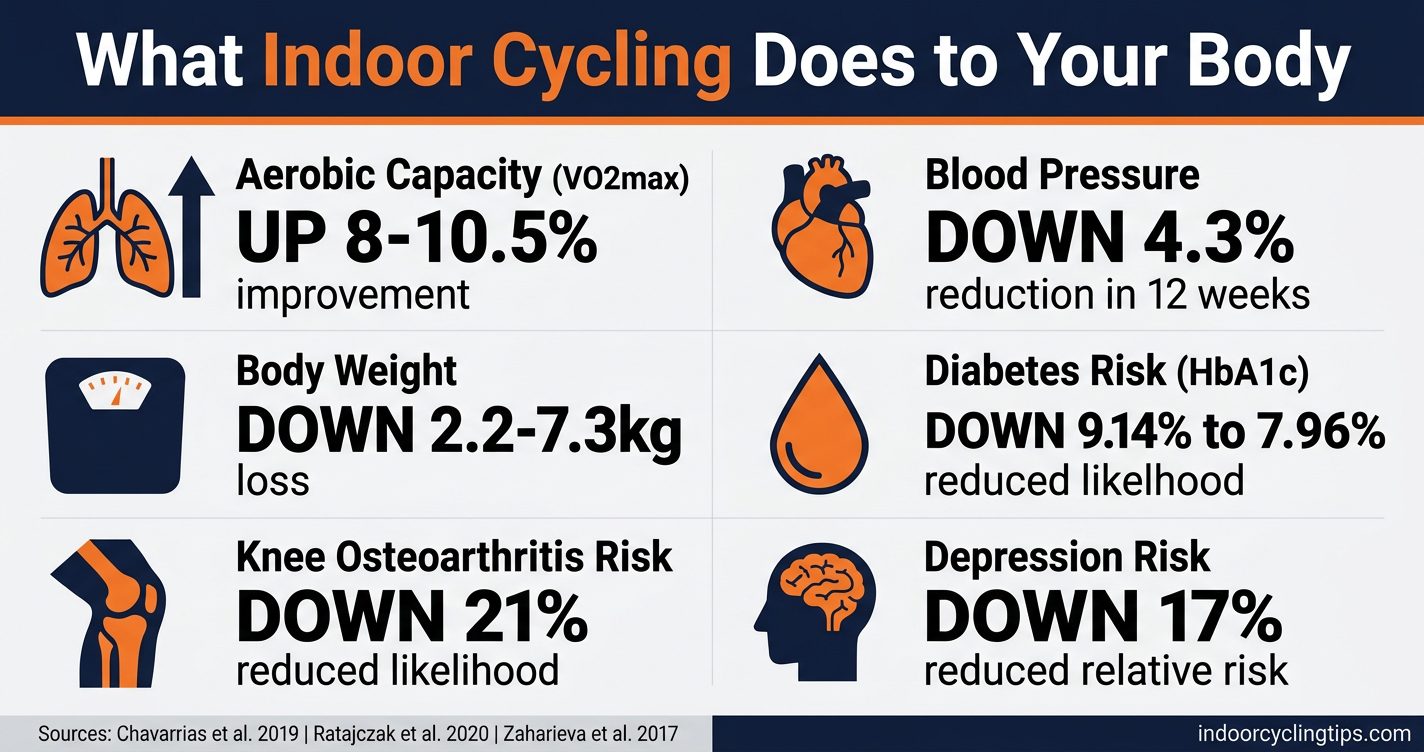
What the evidence does support with reasonable confidence is this: regular indoor cycling produces meaningful improvements in key health markers for most adult populations. The table below summarises the headline findings.
| Health Marker | Outcome | Source |
|---|---|---|
| Aerobic capacity (VO2max) | 8–10.5% improvement | Chavarrias et al., 2019 |
| Systolic blood pressure | 4.3% reduction (12 weeks) | Chavarrias et al., 2019 |
| Body weight | 2.2–7.3 kg loss across interventions | Chavarrias et al., 2019 |
| BMI, waist circumference, cholesterol | Significant reductions | Ratajczak et al., 2020 |
| HbA1c (Type 2 diabetes) | 9.14% → 7.96% over 6 months | Zaharieva et al., Journal of Diabetes & Metabolic Disorders, 2017 |
| Knee osteoarthritis risk | 21% reduced likelihood | Medicine & Science in Sports & Exercise, cited by Stamford Health, 2024 |
| Depression risk | 17% reduced relative risk | AJPM Focus, February 2023 |
Cardiovascular Health Benefits
Indoor cycling is an effective cardiovascular exercise. Regular sessions strengthen the heart muscle, improve circulation, and reduce key risk markers for cardiovascular disease. For a deep dive into the cardiac science, see our dedicated guide to the benefits of indoor cycling for cardiovascular health.
Blood Pressure Reduction
High blood pressure (hypertension) is one of the most significant modifiable risk factors for heart disease and stroke. According to Chavarrias et al. (Medicina, August 2019), a 12-week indoor cycling protocol reduced systolic blood pressure by 4.3%. A more intensive 6-month protocol combining cycling with dietary changes produced an 11.8% reduction in systolic blood pressure.
Even a 4% reduction in systolic pressure is clinically meaningful. Research from the British Medical Journal and other sources consistently shows that small sustained reductions in blood pressure significantly reduce cardiovascular event risk over time.
Cholesterol and Lipid Profile Improvements
Indoor cycling positively affects cholesterol in two directions: it reduces LDL-C (low-density lipoprotein, the “bad” cholesterol) and raises HDL-C (high-density lipoprotein, the “good” cholesterol). According to Ratajczak et al. (International Journal of Environmental Research and Public Health, 24 November 2020), a 12-week indoor cycling programme comprising three 55-minute sessions per week at 65–95% maximum heart rate significantly reduced total cholesterol and increased HDL-C in women aged 40–60 with obesity.
This lipid profile improvement reduces arterial plaque accumulation and lowers long-term cardiovascular disease risk.
Aerobic Capacity (VO2max) Gains
VO2max, the maximum volume of oxygen your body can use during intense exercise, is one of the strongest predictors of long-term health and longevity. According to Chavarrias et al. (Medicina, August 2019), all six studies within their review that measured VO2max showed significant within-group improvements of 8–10.5%. Even participants with fibromyalgia, a condition associated with chronic fatigue and reduced exercise tolerance, showed VO2max gains of approximately 4.8%.
Ratajczak et al. (2020) corroborated this, finding significant increases in VO2 peak in their cohort of women with obesity following a 12-week cycling programme.
Weight Loss and Body Composition
Indoor cycling supports weight loss and improves body composition when performed consistently. It burns a significant number of calories per session, and unlike diet-only interventions, it preserves lean muscle mass while reducing fat.
Calories Burned in an Indoor Cycling Session
According to Harvard Health Publishing, 30 minutes of cycling burns approximately 210–355 calories depending on body weight (125–185 lbs / 57–84 kg). A 45-minute session burns approximately 400–600 calories.
Beyond the session itself, intensity matters for post-exercise calorie burning. A study published in Medicine and Science in Sports and Exercise found that 10 men in their 20s and 30s continued burning more calories than normal for 14 hours after a challenging 45-minute cycling session. This excess post-exercise oxygen consumption (EPOC) effect means high-intensity sessions deliver caloric benefits well beyond the workout window.
For a detailed breakdown of calorie calculations by weight, intensity, and duration, see our guide to how many calories do you burn indoor cycling.
Indoor Cycling Combined with Diet
The most effective approach to weight loss combines indoor cycling with dietary modification. According to Chavarrias et al. (Medicina, August 2019), weight loss across indoor cycling intervention studies ranged from 2.2–7.3 kg. Crucially, the review found that exercise preserved or increased lean muscle mass, whereas diet-only interventions caused muscle loss alongside fat loss.
This is a critical distinction. Preserving muscle mass during a calorie deficit maintains metabolic rate, making long-term weight management more sustainable. For specific strategies, see our guide to how to use indoor cycling to lose belly fat.
Muscle Strength and Which Muscles Indoor Cycling Works
Indoor cycling is primarily a cardiovascular workout, but it is also a meaningful lower-body resistance exercise that develops functional strength across multiple muscle groups.
Primary Muscles Worked
The pedal stroke recruits muscles across the entire lower body in a cyclical, low-impact pattern:
- Quadriceps (front of thigh): The primary driver on the downstroke. These are the largest muscles engaged in cycling and show the greatest hypertrophic response with consistent training.
- Hamstrings (back of thigh): Active on the upstroke, particularly when cycling clips or cages are used to pull through the stroke.
- Glutes (gluteus maximus, medius, minimus): Heavily recruited during climbs and seated heavy-resistance efforts.
- Calves (gastrocnemius and soleus): Engaged throughout the stroke to stabilise the ankle and assist in the push-down phase.
- Hip flexors (iliopsoas): Active on the upstroke and during standing efforts.
For a complete anatomical breakdown of muscle recruitment patterns across different cycling positions and intensities, see our detailed guide to what muscles does indoor cycling work.
Core Engagement and Back Health
Indoor cycling engages the core to a greater extent than many people realise, particularly during standing efforts and high-cadence sprints. The transverse abdominis, obliques, and erector spinae all activate to stabilise the torso and transfer power efficiently through the hips to the pedals.
For riders with lower back pain, this isometric core loading can be beneficial over time, provided bike setup is correct. A poorly fitted bike with excessive forward reach or an overly high saddle can exacerbate lumbar pain rather than relieve it.
Mental Health and Emotional Wellbeing
Indoor cycling benefits extend well beyond the physical. Consistent exercise, including cycling, produces measurable improvements in mood, anxiety, and long-term depression risk.
Endorphins, Serotonin, and Cortisol Regulation
Aerobic exercise triggers the release of endorphins, dopamine, and serotonin, neurotransmitters that regulate mood, motivation, and emotional resilience. It also suppresses cortisol, the primary stress hormone, reducing the physiological impact of chronic stress.
According to a systematic review published in AJPM Focus in February 2023, people with high physical activity levels have a 17% decreased relative risk of incident depression (adjusted RR = 0.83, 95% CI = 0.76–0.90). This finding was consistent across age groups and both sexes.
Indoor cycling, as a moderate-to-vigorous aerobic activity, sits squarely within the exercise category shown to produce these mental health benefits.
Indoor Cycling as Moving Meditation
Many experienced riders describe indoor cycling, particularly solo sessions with rhythm-based music, as a form of moving meditation. The repetitive, rhythmic pedalling action activates the default mode network in ways similar to mindfulness practices, allowing the mind to process, decompress, and reset.
This meditative quality is particularly valuable for individuals who find traditional seated meditation difficult. The physical demand of cycling occupies the body and displaces rumination, while the endorphin release provides a neurochemical platform for improved mood post-session.
Group spin classes add a further layer: social connection, shared effort, and coaching accountability, all of which independently support mental wellbeing.
Joint Health: Why Indoor Cycling Is Low Impact
Indoor cycling is a low-impact exercise. The smooth, circular pedalling motion eliminates the ground-impact forces that accumulate with running, jumping, or high-intensity interval training on hard surfaces. This makes it one of the most joint-friendly cardiovascular options available.
Is Indoor Cycling Safe for People with Knee Pain or Osteoarthritis?
Yes, and the evidence goes further than simply labelling it “safe.” According to a study published in Medicine & Science in Sports & Exercise (cited by Stamford Health, 2024), people who cycled at any point in their lives were 17% less likely to experience knee pain and 21% less likely to develop knee osteoarthritis. The study included over 2,600 participants in their sixties.
A systematic review and meta-analysis of 21 studies involving 1,181 participants (PubMed, PMID 33167714, 2020) found that stationary cycling relieves pain and improves sport function in individuals with knee osteoarthritis.
The mechanism behind this is well established. According to Dr Matt Harkey, a musculoskeletal researcher at Michigan State University (quoted by NPR Health, May 2024), rhythmic pedalling circulates synovial fluid throughout the joint, lubricating cartilage and delivering nutrients to it. Unlike weight-bearing exercise, which compresses the joint, cycling moves it through its range of motion while feeding the cartilage without loading it excessively.
One important caveat: saddle height is critical. According to a biomechanical analysis published via PubMed in 2025, saddle height is a critical risk factor for patellofemoral pain because it changes lower-limb kinematics and increases compressive forces on the knee joint. A saddle set too low dramatically increases knee flexion angle at the top of the pedal stroke, substantially increasing patellofemoral compressive load.
Blood Sugar, Diabetes Prevention, and Metabolic Health
Indoor cycling is an effective tool for managing blood glucose, reducing insulin resistance, and lowering the long-term risk of Type 2 diabetes.
During aerobic exercise, working muscles draw glucose from the bloodstream directly, without requiring insulin to facilitate the transfer. This insulin-independent glucose uptake is what makes aerobic exercise particularly potent for people with or at risk of Type 2 diabetes.
According to Zaharieva et al. (Journal of Diabetes & Metabolic Disorders, 2017, PMC5583829), young individuals with Type 2 diabetes who cycled 25 km per day for at least 5 days per week saw their mean HbA1c drop from 9.14% to 7.96% over six months (p<0.001). An HbA1c reduction of this magnitude represents a clinically meaningful improvement in long-term blood glucose control and a significant reduction in diabetes complication risk.
For those seeking faster results, high-intensity protocols are also effective. According to a meta-analysis published in Frontiers in Endocrinology in 2025, HIIT cycling, specifically 10 × 60-second bouts at approximately 90% of maximum heart rate, performed across 5 sessions over 2 weeks, lowered average 24-hour blood glucose readings.
The broader mortality picture is equally compelling. According to the Observatoire de prévention, Institut de Cardiologie de Montréal (November 2021), cycling is associated with a reduction of at least 22% in the risk of premature mortality in adults with diabetes.
Indoor Cycling vs. Outdoor Cycling: How Do the Benefits Compare?
Both indoor and outdoor cycling deliver substantial health benefits, but they differ meaningfully in controllability, environmental variables, injury risk, and the psychological experience of riding.
For a comprehensive breakdown of both options, see our full comparison guide: indoor vs outdoor cycling.
Comparison Table
| Benefit Dimension | Indoor Cycling | Outdoor Cycling |
|---|---|---|
| Cardiovascular benefit | High: easily controlled via resistance and cadence | High: natural terrain variation |
| Calorie burn | Comparable per session at matched intensity | Slightly higher at matched effort due to wind resistance |
| Weather dependency | None: year-round | High: season and conditions dependent |
| Joint impact | Low | Low to moderate (road surface vibration) |
| Safety | Very high: no traffic, no falls from road hazards | Moderate: traffic, road surfaces, falls |
| Muscle engagement | Lower body dominant; reduced upper body engagement | Lower body dominant; more upper body stabilisation on technical terrain |
| Mental health | Good: music, group classes, coached platforms | Excellent: nature exposure enhances mood benefit |
| Enjoyment | Lower in some users | Higher: fresh air, scenery, social riding |
| Data/training control | Excellent: resistance, watts, cadence all precise | Good: GPS, power meters, but terrain varies |
| Accessibility | High: home setup or gym, no commute | Variable: requires infrastructure, safe roads |
| Heart rate response | Higher at matched perceived effort (indoor heat) | Slightly lower for equivalent perceived effort |
The heart rate finding is notable. According to Poli et al. (Journal of Functional Morphology and Kinesiology, 2 October 2024), in a randomised controlled trial at the University of Bari, Italy (n=31), enhanced reality indoor cycling produced a higher mean heart rate (111.3 bpm) than outdoor cycling (102.4 bpm) at comparable perceived exertion. However, outdoor cycling scored higher on enjoyment (PACES: 71.0 vs. 64.8) and intrinsic motivation.
The practical takeaway: indoor cycling may actually produce a higher cardiovascular training stimulus per session, but outdoor cycling may be easier to sustain long-term because it is more enjoyable. The best exercise is the one you will actually do consistently.
Risks, Precautions, and Who Should Be Careful
Indoor cycling is safe for most people, but like any exercise modality, it carries risks when performed incorrectly, too frequently, or without appropriate physical preparation.
Common Overuse Injuries
According to a PubMed-indexed systematic review (PMC12278157), between 50–90% of cyclists experience overuse injuries depending on population and modality, with the knee being the most commonly affected joint. The primary overuse injuries in indoor cycling include:
- Patellofemoral pain syndrome (runner’s knee): Caused by excessive knee flexion, incorrect saddle height, or high cadence with inadequate resistance.
- Iliotibial band syndrome: Lateral knee pain caused by saddle height being too high, forcing the hip to rock at the top of the stroke.
- Lower back pain: Often associated with excessive forward lean, low saddle height, or prolonged sessions without adequate core strength.
- Achilles tendinopathy: Can result from incorrect foot position on the pedal (excessive toe-down or heel-up).
- Neck and shoulder tension: Common in riders who grip the handlebars tightly or set them too low.
Most of these injuries are preventable with correct bike setup and progressive training loads.
Saddle Soreness and How to Prevent It
Saddle soreness is the most commonly cited barrier for new indoor cyclists, and it is entirely manageable. The perineal area and sit bones are not accustomed to sustained pressure at the outset, and most beginners experience discomfort in their first two to three weeks of regular cycling.
Prevention strategies include:
- Invest in padded cycling shorts (bib shorts or regular shorts with a chamois pad). This is the single highest-impact intervention for saddle comfort.
- Use chamois cream to reduce friction and prevent skin breakdown.
- Adjust saddle height correctly, see the guidance in the ultimate guide to setting up your indoor cycling bike.
- Build session duration gradually, start with 20-minute sessions and increase over 2–3 weeks.
- Do not sit on the saddle for 100% of the session, standing intervals redistribute pressure and give the perineal area rest.
Most riders find saddle soreness resolves within 3–6 weeks as soft tissue adapts and cycling-specific habits form.
Who Should Consult a Doctor First
Most healthy adults can begin indoor cycling without medical clearance. However, the following groups should consult a GP or specialist before starting:
- People with cardiovascular disease or a recent cardiac event. High-intensity cycling significantly elevates heart rate and blood pressure. A graded exercise test under medical supervision may be appropriate first.
- People with severe osteoarthritis or recent joint replacement surgery. While cycling is generally recommended for arthritis, the specific range of motion and loading demands should be confirmed with a physiotherapist.
- People with uncontrolled hypertension. Vigorous exercise temporarily raises blood pressure; medication and blood pressure should be stable before initiating high-intensity sessions.
- People with Type 2 diabetes on insulin or sulphonylureas. Exercise significantly lowers blood glucose, and dosing may need adjustment to prevent hypoglycaemia during or after sessions.
- Pregnant women. Indoor cycling is generally considered safe during uncomplicated pregnancies, but a midwife or obstetrician should be consulted, particularly for high-intensity formats.
How to Get Started with Indoor Cycling for Health Benefits
The barrier to entry for indoor cycling is lower than most people assume. You do not need an expensive smart trainer or a Peloton subscription to get the health benefits described in this article. A basic upright stationary bike and a consistent schedule are sufficient. For a complete beginner’s framework, see our guide to how to start indoor cycling for fitness.
How Many Sessions Per Week Do You Need?
According to the WHO 2020 Guidelines on Physical Activity and Sedentary Behaviour, adults should accumulate 150–300 minutes of moderate-intensity or 75–150 minutes of vigorous-intensity aerobic activity per week. Currently, 25% of adults worldwide fail to meet these guidelines.
Three 55-minute sessions of moderate-to-vigorous indoor cycling per week exceeds the lower bound of the WHO moderate-intensity recommendation. This is the protocol used in the Ratajczak et al. (2020) study that produced significant improvements in BMI, cholesterol, waist circumference, and aerobic capacity.
For most beginners, starting with three sessions per week and progressing to four or five as fitness improves is a practical target. Rest days are important, overtraining is a real risk, particularly in motivated beginners who ramp up volume too quickly.
How Long Should Your Sessions Be?
Session length depends on your current fitness level and goals:
- Beginners (weeks 1–4): 20–30 minutes at moderate intensity (65–70% maximum heart rate). Focus on technique and consistency, not duration.
- Intermediate (months 2–4): 40–55 minutes, incorporating interval efforts at 75–85% maximum heart rate.
- Ongoing maintenance: 45–60 minutes, mixing endurance rides with HIIT sessions.
For a research-backed breakdown of optimal session length, see our guide on the ideal length for indoor cycling sessions.
Beginner Tips for Proper Bike Setup
Correct bike fit is the most important variable in both injury prevention and performance. A poorly set up bike makes cycling uncomfortable, reduces the effectiveness of the workout, and dramatically increases injury risk. The critical setup points are:
- Saddle height: When your pedal is at the lowest point of the stroke (6 o’clock position), your knee should have a slight bend, approximately 25–35 degrees of knee flexion. Too low increases patellofemoral load. Too high causes hip rocking and iliotibial band strain.
- Saddle fore-aft position: When the pedal is at the 3 o’clock position, your kneecap should be directly above the pedal axle.
- Handlebar height: Set at saddle height or slightly above for beginners. Lowering the bars (as road cyclists often prefer) increases forward lean and lumbar load.
- Handlebar reach: Arms should have a slight bend at the elbow when holding the bars. Excessive reach stresses the neck and shoulders.
For full setup instructions with visual guidance, see the ultimate guide to setting up your indoor cycling bike.
Frequently Asked Questions
Is indoor cycling good for weight loss?
Yes, indoor cycling is effective for weight loss, particularly when combined with dietary changes. According to Chavarrias et al. (Medicina, August 2019), weight loss across indoor cycling intervention studies ranged from 2.2–7.3 kg. The exercise component preserved or increased lean muscle mass, an outcome that diet-only approaches consistently fail to achieve, since caloric restriction without exercise causes muscle breakdown alongside fat loss.
At the calorie level, Harvard Health Publishing figures show a 45-minute cycling session burns approximately 400–600 calories depending on body weight and intensity. A study published in Medicine and Science in Sports and Exercise found that 10 men continued burning more calories than normal for 14 hours after a challenging 45-minute cycling session, due to the EPOC (excess post-exercise oxygen consumption) effect. For weight loss, three to five sessions per week at moderate-to-vigorous intensity, combined with a moderate caloric deficit, is a well-supported approach. Consistency matters more than intensity in the early stages.
How often should I do indoor cycling to see health benefits?
The WHO 2020 Guidelines on Physical Activity and Sedentary Behaviour recommend 150–300 minutes of moderate-intensity or 75–150 minutes of vigorous-intensity aerobic activity per week. For indoor cycling, this translates to approximately three to five sessions per week of 30–60 minutes.
Research supports this frequency. The Ratajczak et al. study (2020) used three 55-minute sessions per week over 12 weeks and produced significant improvements in BMI, waist circumference, total cholesterol, C-reactive protein, VO2 peak, and HDL-C. The Chavarrias et al. (2019) review found meaningful cardiovascular and body composition benefits across a range of protocols, with most interventions running 8–16 weeks. For beginners, starting with three sessions per week is sufficient to drive adaptation. Increasing to four or five sessions should happen gradually over 4–8 weeks to avoid overuse injuries, which affect 50–90% of cyclists who ramp up volume too quickly (PMC12278157).
Is indoor cycling hard on your knees?
Properly performed indoor cycling is not hard on your knees, in fact, it may protect them. According to a study published in Medicine & Science in Sports & Exercise (cited by Stamford Health, 2024), people who cycled at any point in their lives were 17% less likely to experience knee pain and 21% less likely to develop knee osteoarthritis. The study included over 2,600 participants in their sixties.
A systematic review and meta-analysis of 21 studies involving 1,181 participants (PubMed, PMID 33167714, 2020) found stationary cycling relieves pain and improves sport function in people with existing knee osteoarthritis. The key protective mechanism, according to Dr Matt Harkey (musculoskeletal researcher, Michigan State University, NPR Health, May 2024), is that rhythmic pedalling circulates synovial fluid throughout the joint, lubricating cartilage and delivering nutrients to it. The important caveat is saddle height: a 2025 PubMed biomechanical analysis found that incorrect saddle height significantly increases compressive forces on the knee joint. Set your saddle height correctly before every session.
Can indoor cycling improve mental health?
Yes. Aerobic exercise, including indoor cycling, is one of the most evidence-supported interventions for mental health outside of pharmaceutical therapy. According to a systematic review published in AJPM Focus in February 2023, people with high physical activity levels have a 17% decreased relative risk of incident depression (adjusted RR = 0.83, 95% CI = 0.76–0.90).
The neurochemical mechanism involves increased release of endorphins, dopamine, and serotonin during aerobic exercise, alongside reduced cortisol (the primary stress hormone). Indoor cycling offers additional mental health advantages beyond the biochemical: structured group spin classes provide social connection and accountability; solo sessions with music or podcasts offer a decompression ritual distinct from screen time; and the rhythmic nature of pedalling has been described by researchers and practitioners as a form of moving meditation that reduces rumination. Most riders report mood improvement within a single session. Long-term consistent cycling builds emotional resilience over weeks and months.
Is it safe to do indoor cycling every day?
Daily indoor cycling is possible, but it is not optimal for most people, particularly beginners. Recovery is when the body adapts to exercise stress, without it, fitness gains plateau and overuse injury risk escalates sharply. The research protocol most commonly associated with significant health improvements (Ratajczak et al., 2020) used three sessions per week, not daily riding.
That said, daily low-intensity cycling, what cyclists call “active recovery” or Zone 1 riding, is entirely appropriate and does not interfere with recovery. The issue arises with daily moderate-to-high-intensity efforts. According to PubMed-indexed research (PMC12278157), between 50–90% of cyclists experience overuse injuries, with the knee being the most commonly affected joint. The risk is highest when volume increases too rapidly. A sustainable programme for health purposes is four to five sessions per week with one or two full rest days and at least one low-intensity session. If you wish to ride daily, alternate hard and easy days and monitor for joint discomfort, fatigue, and declining performance, all signs of insufficient recovery.
Does indoor cycling help with diabetes?
Yes, the evidence here is particularly strong. During aerobic cycling, working muscles absorb glucose from the bloodstream directly, bypassing the insulin resistance that characterises Type 2 diabetes. This insulin-independent glucose uptake makes cycling an acutely effective blood glucose management tool.
According to research indexed on PMC (PMC5583829), young individuals with Type 2 diabetes who cycled 25 km per day for at least 5 days per week saw their mean HbA1c drop from 9.14% to 7.96% over six months (p<0.001). This is a clinically significant improvement. A meta-analysis published in Frontiers in Endocrinology (2025) found that HIIT cycling (10 × 60-second bouts at approximately 90% of maximum heart rate, 5 sessions over 2 weeks) also lowered average 24-hour blood glucose readings. On the long-term mortality dimension, the Observatoire de prévention, Institut de Cardiologie de Montréal (November 2021) found that cycling is associated with a reduction of at least 22% in the risk of premature mortality in adults with diabetes. People managing diabetes with insulin or sulphonylureas should consult their doctor before starting, as exercise significantly lowers blood glucose and medication dosing may need adjustment.