

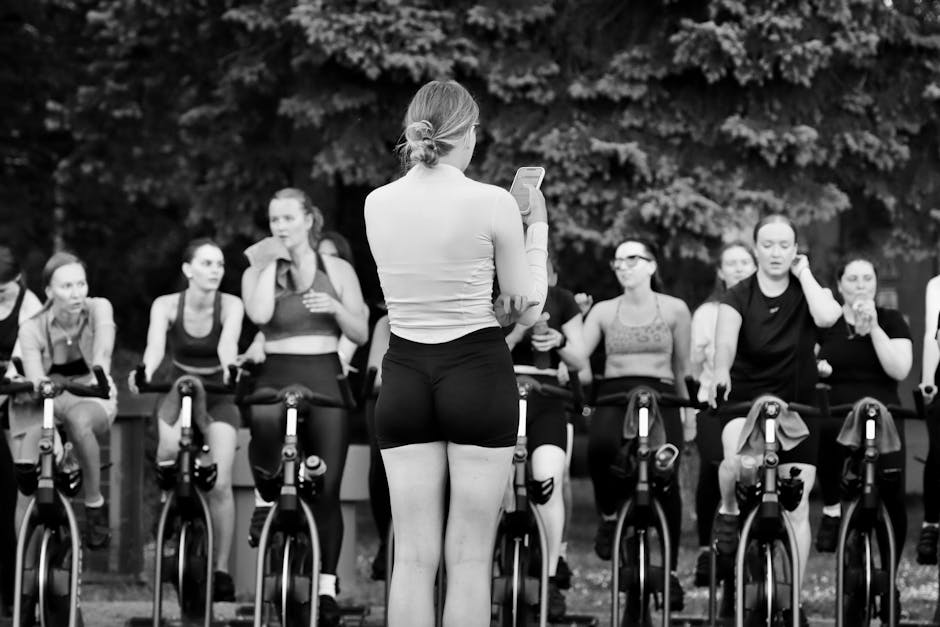
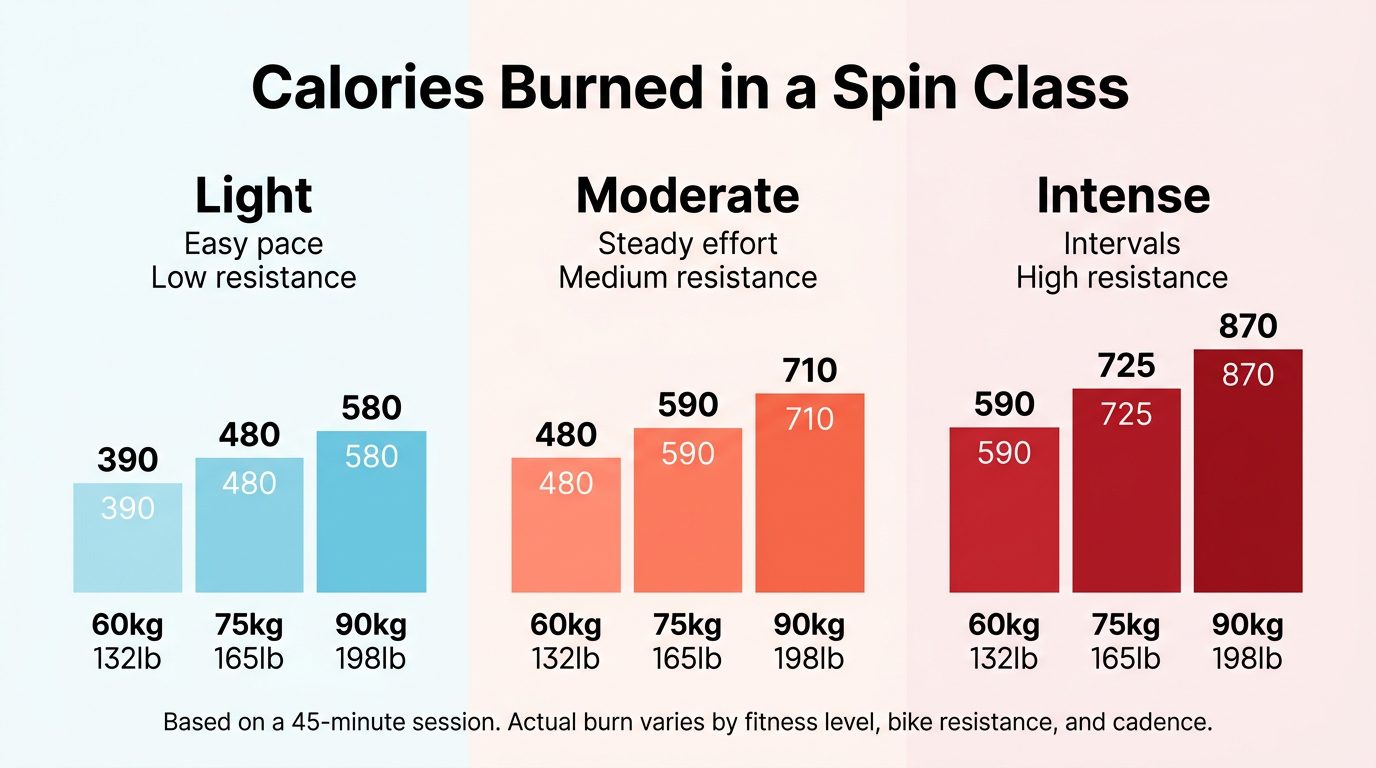
A spin class burns between 400 and 600 calories in a standard 45-minute session at moderate-to-vigorous intensity for the average adult. The exact number depends on body weight, resistance level, cadence, and the proportion of the class spent at high output.
TL;DR
A standard 45-minute spin class burns 400–600 calories for most people, and a 60-minute session can reach 500–800 calories depending on your body weight and effort level.
| Session Length | Light Effort | Moderate Effort | Vigorous Effort |
|---|---|---|---|
| 30 minutes | 150–210 cal | 210–315 cal | 315–420 cal |
| 45 minutes | 220–315 cal | 315–470 cal | 470–630 cal |
| 60 minutes | 300–420 cal | 420–630 cal | 630–840 cal |
What Is Calorie Burn in a Spin Class?
Spinning achieves its caloric expenditure through continuous lower-body muscular effort against a weighted flywheel, raising heart rate to 60–90% of maximum for sustained periods. According to the 2024 Adult Compendium of Physical Activities (Ainsworth et al., 2024), an RPM/Spin bike class carries a MET (Metabolic Equivalent of Task) value of 9.0, roughly nine times the energy cost of sitting still.
That MET value places spin class in the same bracket as vigorous running at 8.5 km/h, making it one of the higher-calorie-per-minute gym activities available. Because spinning is non-weight-bearing, injury rates are significantly lower. Ground reaction forces during cycling are approximately 1.1× body weight versus 2.5–3× body weight when running.
How Is Calorie Burn Calculated in a Spin Class?
Calorie burn during exercise is estimated using the MET formula, which adjusts for body weight and session duration:
Calories burned = (MET × 3.5 × body weight in kg ÷ 200) × duration in minutes
MET Values for Indoor Cycling (2024 Compendium)
| Activity | MET Value |
|---|---|
| RPM / Spin bike class | 9.0 |
| Indoor cycling, HIIT | 8.8 |
| Indoor cycling, interactive virtual (e.g. Zwift) | 8.8 |
| Stationary bike, moderate effort | 5.5 |
| Stationary bike, vigorous effort | 8.0 |
, pacompendium.com (Ainsworth et al., 2024)Worked Example
A 75 kg rider in a 45-minute spin class at MET 9.0: (9.0 × 3.5 × 75 ÷ 200) × 45 = 531 calories. The same rider at vigorous-but-not-class-level effort (MET 8.0): (8.0 × 3.5 × 75 ÷ 200) × 45 = 472 calories.
Calorie Burn by Body Weight and Duration
| Body Weight | 30 min | 45 min | 60 min |
|---|---|---|---|
| 55 kg (121 lb) | 260 | 390 | 520 |
| 65 kg (143 lb) | 307 | 460 | 614 |
| 70 kg (154 lb) | 331 | 496 | 661 |
| 75 kg (165 lb) | 354 | 531 | 709 |
| 80 kg (176 lb) | 378 | 567 | 756 |
| 90 kg (198 lb) | 425 | 638 | 850 |
| 100 kg (220 lb) | 473 | 709 | 945 |
| 110 kg (243 lb) | 520 | 780 | 1,040 |
Harvard Health (2021) provides a complementary reference: a 125 lb (57 kg) person burns 210 calories in 30 minutes of moderate stationary cycling; a 155 lb (70 kg) person burns 252 calories; a 185 lb (84 kg) person burns 294 calories. A vigorous spin class sits considerably above those moderate figures.
What Factors Change How Many Calories You Burn?
1. Body Weight
Weight is the single strongest predictor in the formula. A 110 kg rider doing the same 45-minute class as a 60 kg rider burns approximately 70% more calories (780 vs 460 calories). More mass requires more energy to keep moving.
2. Resistance and Effort Level
Increasing the flywheel resistance raises watts, which directly increases caloric expenditure. Spinning at 150 watts burns substantially more than spinning at 80 watts even at the same cadence. High-resistance climb segments deliver the greatest metabolic demand per minute.
3. Session Duration
Longer sessions accumulate more total calories linearly, but intensity matters more per minute. A 20-minute HIIT spin session at maximum effort can match or exceed the calorie burn of a 45-minute leisurely ride (Cleveland Clinic, 2024).
4. Fitness Level
As cardiovascular fitness improves, the body becomes more efficient. Improved fitness allows riders to sustain higher intensities, generating greater absolute calorie burn even if the calories-per-minute rate at easy effort decreases.
5. The Afterburn Effect (EPOC)
High-intensity cycling triggers Excess Post-Exercise Oxygen Consumption (EPOC): your body continues burning calories at a higher rate for hours after the class ends. According to the Cleveland Clinic (2024), EPOC typically adds approximately 7% to total session energy expenditure. During HIIT-format spin classes, this effect is amplified; a 2021 PMC study (Skelly et al., 2021) found HIIT generates meaningfully greater EPOC than continuous moderate exercise.
Examples: Calorie Calculations for Different Riders
Example 1: The Weekday Warrior (70 kg, 45-minute class)
Using MET 9.0: (9.0 × 3.5 × 70 ÷ 200) × 45 = 496 calories. Adding ~7% EPOC: approximately 531 calories total. Three classes per week: ~1,500–1,600 calories of direct energy expenditure weekly.
Example 2: The Beginner (85 kg, 30-minute class)
At moderate effort (MET ~5.5): (5.5 × 3.5 × 85 ÷ 200) × 30 = 245 calories. At full class-level intensity (MET 9.0), the same session yields 401 calories, a 64% increase from the same time investment.
Example 3: The Experienced Rider (65 kg, 60-minute intense class)
Using MET 9.0: (9.0 × 3.5 × 65 ÷ 200) × 60 = 614 calories. With HIIT-driven EPOC at ~12%: approximately 688 calories total.
Example 4: The Heavier Rider (100 kg, 45-minute class)
Using MET 9.0: (9.0 × 3.5 × 100 ÷ 200) × 45 = 709 calories. Spin class is particularly effective for heavier individuals. Calorie burn scales proportionally with mass, and the low-impact format prevents the joint stress associated with running.
How Does Spin Class Compare to Other Cardio?
| Activity | Calories (30 min) | Impact Level | EPOC Potential |
|---|---|---|---|
| Spin class (MET 9.0) | 331 | Low | High |
| Running at 9.5 km/h (MET 9.8) | 360 | High | High |
| Rowing machine, vigorous (MET 8.5) | 312 | Low–Medium | Medium |
| Swimming, vigorous (MET 9.8) | 360 | Low | Medium |
| Elliptical, vigorous (MET 7.5) | 276 | Low | Medium |
| Walking at 6.5 km/h (MET 4.3) | 158 | Low | Low |
Spin class burns slightly fewer calories per minute than running at equivalent intensity, but the low-impact nature means most people can sustain it for longer and attend more sessions per week without injury risk. For more on how spin class fits into a broader fitness strategy, see Is Indoor Cycling Good For You? : the full evidence review covering the broader health benefits on this site.
How to Maximise Calorie Burn in a Spin Class
- Increase resistance during climbs. Adding flywheel resistance during climb segments is the fastest way to boost per-minute calorie burn.
- Use heart rate zones. Aim to spend at least 20 minutes per 45-minute session at 75–85% of maximum heart rate (Zone 4). This is where EPOC is maximised.
- Don’t skip the high-intensity intervals. Sprint and surge intervals drive disproportionate calorie burn and EPOC.
- Attend consistently. Three sessions per week generates ~1,500 calories of direct exercise expenditure weekly.
- Match session length to your goal. If fat loss is the priority, a 60-minute class produces meaningfully more total calorie burn than a 30-minute session.
Frequently Asked Questions
How many calories does a 200 lb (90 kg) person burn in a spin class?
A 200 lb (approximately 90 kg) person burns approximately 638 calories in a 45-minute spin class and around 850 calories in a 60-minute session, using the MET 9.0 value for an RPM/Spin bike class from the 2024 Adult Compendium of Physical Activities (Ainsworth et al., 2024). At lighter effort (MET ~5.5), the same 45-minute session yields approximately 390 calories. Three 45-minute classes per week generates a direct calorie deficit of approximately 1,900 calories weekly from exercise alone.
Is spin class better for calorie burn than running?
Spin class and running burn comparable calories at equivalent intensities. Running at 9.5 km/h burns approximately 360 calories versus 331 calories for spin class over 30 minutes, a difference of under 10%. Spin class has a meaningful practical advantage: it is lower-impact. Cycling’s ground reaction forces are approximately 1.1× body weight compared to 2.5–3× for running. Someone who can attend spin class four times per week without injury accumulates more total calorie expenditure than someone who runs twice and needs two days to recover.
Does spin class burn belly fat specifically?
No form of exercise preferentially burns fat from specific body regions; spot reduction is not supported by the scientific literature. What spin class does is create a significant calorie deficit which, sustained over time alongside appropriate nutrition, reduces total body fat including abdominal fat. HIIT-format spin classes have been associated with greater reductions in visceral fat compared to steady-state cardio, according to research cited by the Cleveland Clinic (2024), mediated through hormonal responses to high-intensity effort, not localised fat burning.
How accurate are the calorie readouts on spin bikes?
Spin bike calorie displays are notoriously inaccurate. Most display units use simplified formulas that do not account for body weight, fitness level, or actual power output. Independent testing has found that many stationary bike displays overestimate calorie burn by 15–40% (BodySpec, 2024). For a more accurate estimate, use the MET-based formula above with your own body weight, or use a power meter-equipped bike that measures actual watts.
Can I lose weight by only doing spin classes?
Spin class can be a highly effective component of a weight-loss programme, but nutrition drives the majority of fat-loss results. Three 45-minute spin classes per week creates approximately 1,500 calories of weekly exercise expenditure for a 70 kg person, equivalent to roughly 0.2 kg of fat loss per week from exercise alone. Spin class works best when combined with a structured nutrition plan rather than used in isolation.
Key Takeaways
- A 45-minute spin class burns 400–600 calories for most people; a 60-minute class burns 500–840 calories.
- Calorie burn scales directly with body weight; heavier riders burn significantly more for the same effort.
- The 2024 Adult Compendium of Physical Activities assigns a MET of 9.0 to an RPM/Spin bike class.
- HIIT-format classes add approximately 7–15% more calories post-session through the EPOC effect.
- Spin class burns comparable calories to running at equivalent effort but with a fraction of the injury risk.
- Bike display readouts overestimate calorie burn by up to 40%. Use the MET formula for accurate estimates.
- For the broader health benefits of indoor cycling, read Is Indoor Cycling Good For You?